Sober homepage of F.A. Muller



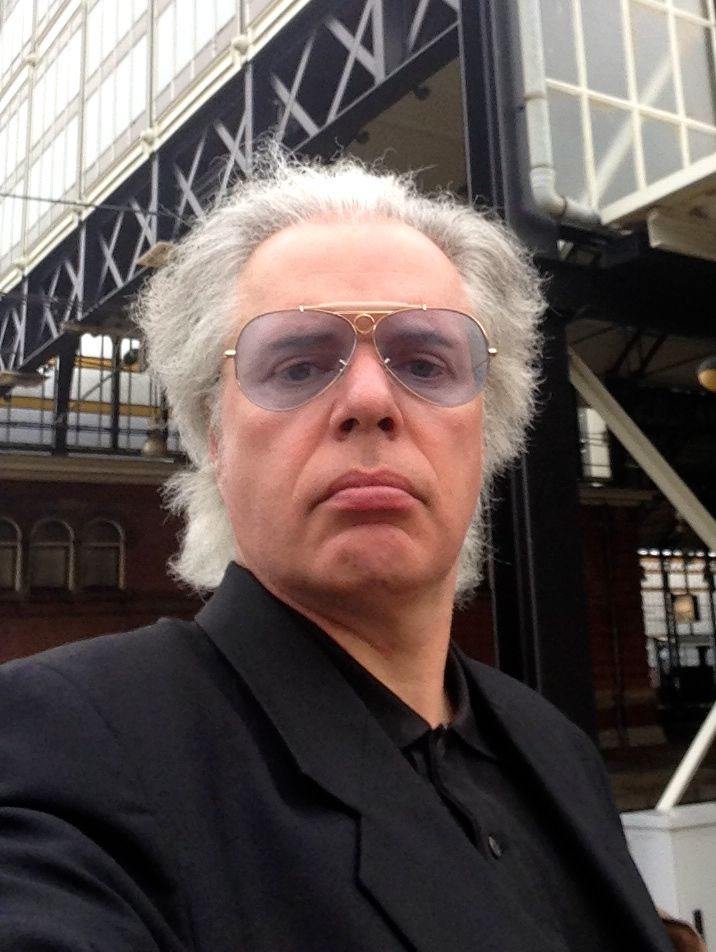
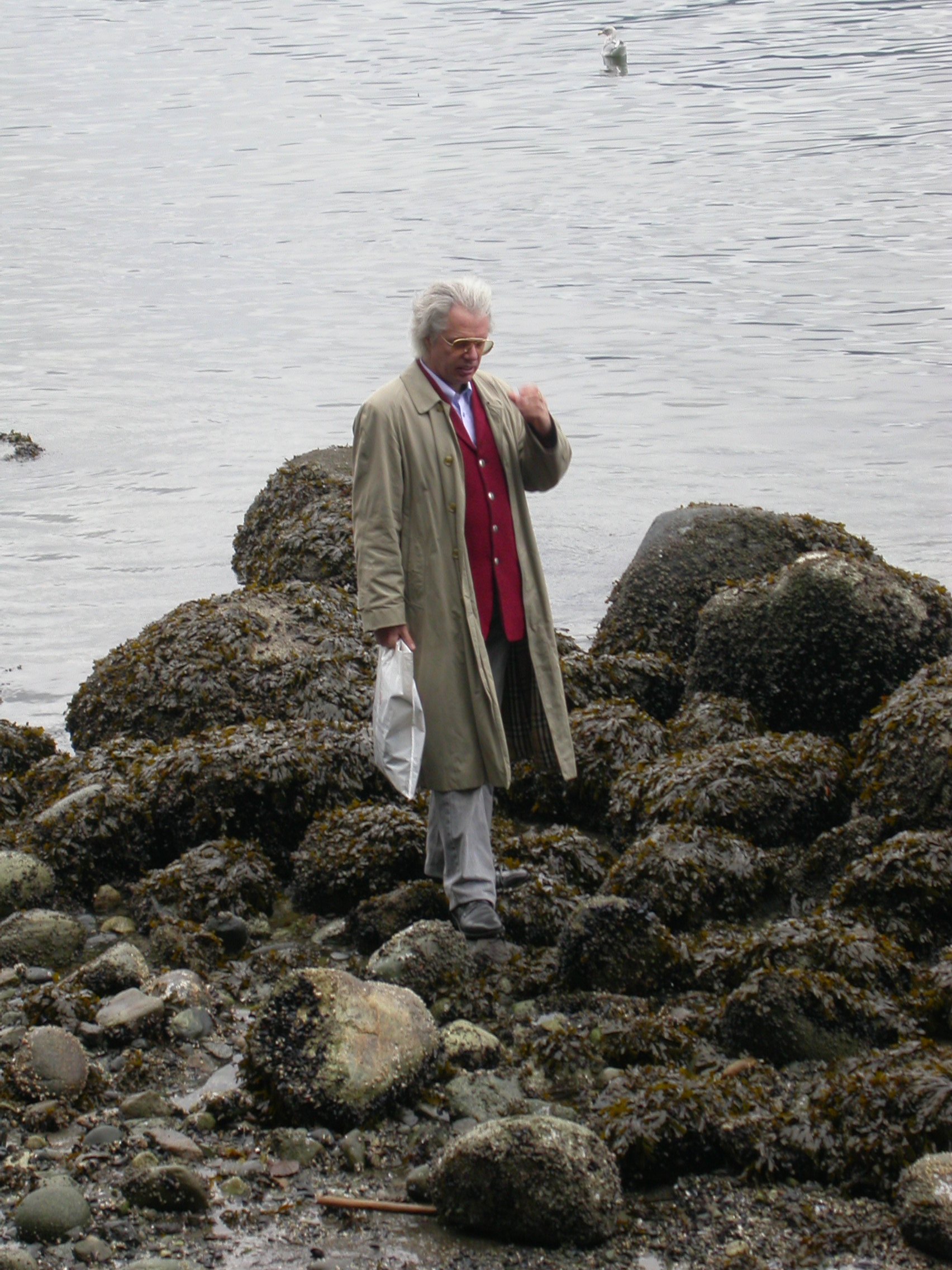
- Curriculum Vitae
- Experience and Skills
- Selected Academic Publications
- Selected Other Publications
(in Dutch)
- Structures for Everyone
- Additional Links
Life. I was
born in Amsterdam, the Netherlands (Europe),
in January 1962. The head-master of my primary school
perceived talent for music in my person when he heard
me sing. History has proved him wrong. I wanted
to become a zoologist anyway. Then I discovered there are
no wild animals in Holland. The boring biology-lessons in
secondary school, with their emphasis on seeds, plants
and the Holy Environment, annihilated my ambition to become a zoologist.
In my final examination of secondary school
I ended as the top of my class (May 1978).
From September 1978 to August 1983,
I followed a vocational course, obtaining qualifications
that allow me to teach physics and mathematics at
intermediate level (secondary school).
When I was about 18 years old, I
sensed that my destiny was to become a philosopher-scientist
and acted accordingly. Occasionally I also hear the voice
of a literary vocation calling,
which manages to perturb my worldline at times --- see
for this
Het Bloedbad and
De Muur.
Undergraduate Studies.
From September 1983 to August 1989, I
followed a six year programme at the Free University of
Amsterdam, comprising: theoretical physics (main subject;
passed examinations with distinction --- cum laude);
elements of mathematics; philosophy
of science; history of the natural sciences; history of philosophy;
basic Latin. Some of my undergraduate work on theoretical nuclear
physics has been published. I partly funded myself
with money earned by teaching private pupils,
by teaching in a private school and by organising
gambling games.
More Life.
The first half of 1990 I spent in Africa,
mostly in Tunisia, where among other things I earned
some money by performing simple manual labour, such as
slaughtering chickens.
I did not return to Holland empty-handed, for in August 1990 I married
a Tunisian woman (in Amsterdam) I had met in Tunis; our offspring consists of
two sons, Souleyman (1993-2010), who was killed in a traffic accident at the age
of 17 years and 1 week,
Faysal (1994), and one daughter, Olfa (1998).
Advanced Studies. Since October
1991 I have been active as
a graduate student in the foundations and philosophy
of science at Utrecht University,
busily engaged in fulfilling my destiny. I followed
courses in logic, philosophy
of quantum theory and philosophy of space and time
(mostly relativity theory).
In November 1998 I publicly defended my omnious
and multidisciplinary
Thesis Structures for Everyone.
Contemplations and proofs in the foundations and
philosophy of physics and mathematics .
Part of my Thesis is published in two
parts in Studies in the History and Philosophy of Modern
Science B and my Thesis is published in its entirety
as a 600 page book.
In the beginning of 1999 I gave a private course `Philosophy
and Quantum Mechanics' in Amsterdam (co-organised with
the theologian-philosopher-thief
J.A.G.M. Rutten); it was attended by fifteen persons.
A short version I have given at the International School
of Philosophy (see below).
From March 2000 until June 2004 I was post-doctoral
researcher, funded by the Dutch Science Organisation (NWO),
for a period of 3 years and 9 months (4 days a week).
My working home base therefore remains Utrecht University.
Since July 2005 I work officially at the Philosophy Faculty of
Erasmus University Rotterdam; in Utrecht I am a `guest-researcher'.
Areas of Specialisation, Competence and Interest.
-
AOS: foundations and philosophy
of physics, of mathematics and of logic,
philosophy of science.
-
AOC: general philosophy, history of philosophy, analytic
philosophy, physics, mathematics.
-
AOI: literature, music, art, aesthetics.
Beliefs. I believe that life is absurd,
horrible and good for a few laughs and more tears. I believe that when we
die, our world comes to an end --- the most disturbing
prospect we all have to come to terms with in one way or another.
I believe that reason and imagination are the quintessential attributes of
our species, which somehow emerge from those staggering
constellations of quarks & leptons that we are, and which has
evolved, slowly and haphazardly, from green slime that once
drifted in the primal soup on planet Earth.
Back to Contents.


-
Bachelor Courses
Philosophy of Science
Philosophy of Mind
Philosophy of Knowledge (Epistemology)
Philosophy of Language
Philosophy and Film
Philosophical Atelier
Feyerabend Festival
-
Masters Courses
Philosophy of Matter: Quantum Ontology
Unification and Explanation
Logic
Truth
Language and Reality
Whitehead's Process and Reality
Advanced Metaphysics (Philosophy of Reality)
Advanced Philosophy of Mind
Consciousness from all sides
-
Guest Lectures in other Courses
Kafka and Philosophy
Analytic Metaphysics
Continental Metaphysics
Philosophy of Knowledge (Epistemology)
Thought Experiments
Philosophy of Science in Psychology
Back to Contents.
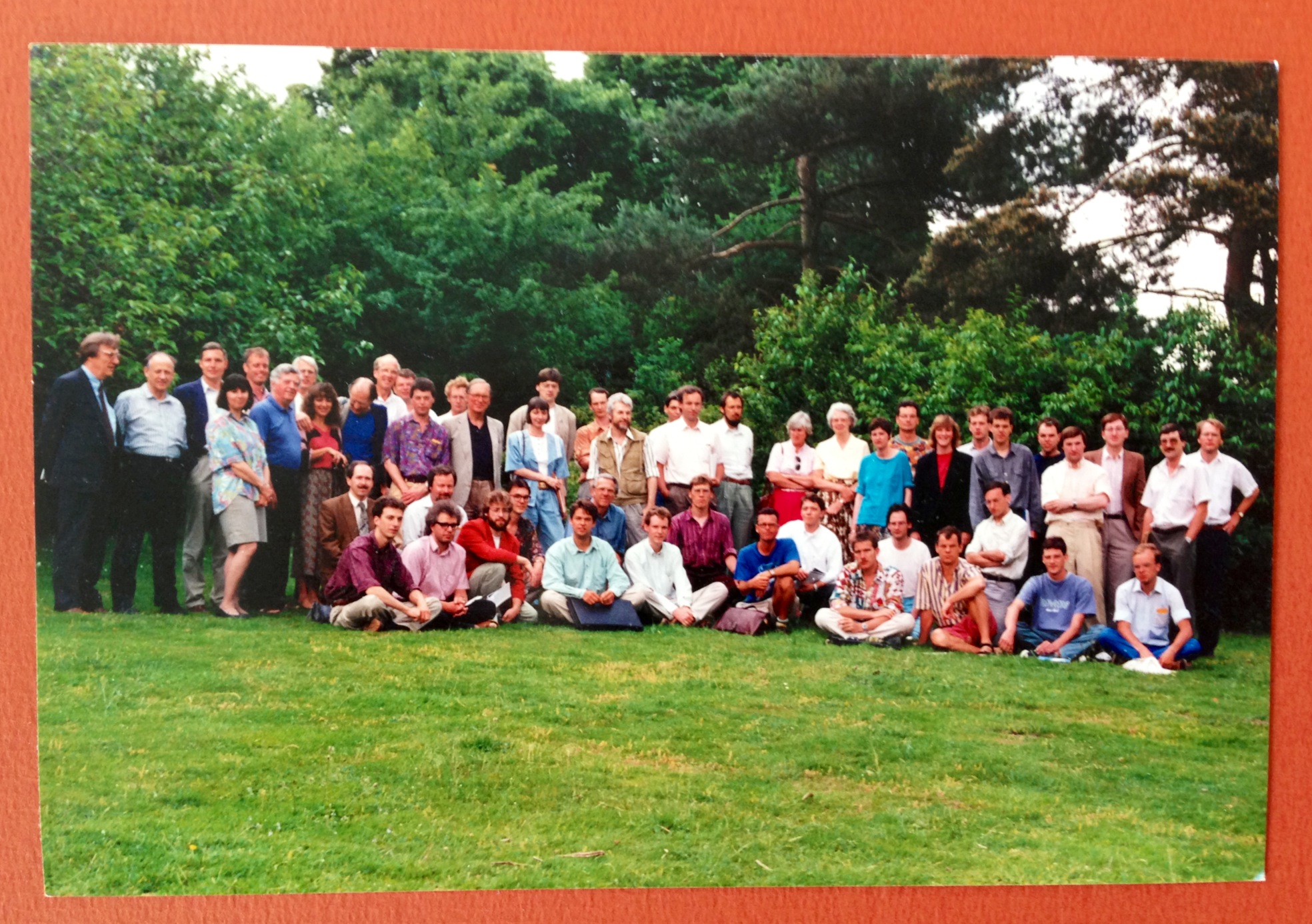
Ascension Symposium, Arnhem 1994
-
`The Dyson Equation. An application of quantum field-theoretic
techniques to the many-body problem in nuclear physics',
undergraduate thesis (partly published in the next item),
July 1988.
-
`Fragmentation of Single-Particle Strength and the Validity of
the Shell Model',
Nuclear Physics A531 (1991) 253--284 (co-author).
-
`On the Principle of Relativity',
Foundations of Physics Letters 5 (1992) 591-596.
-
`Worldlines are Growing! On Ontological Fatalism, Temporal
Becoming and the Special Theory of Relativity', May 1992,
unpublished; discussed by R. Clifton and M. Hogarth in Synthese
103 (1995) 355-387.
-
`Philosophy of Physics for Pedestrians', Studies
in the History and Philosophy of Modern Science
25 (1994) 505-509.
-
`On
Stochastic Einstein Locality in Algebraic Quantum Field
Theory', International Journal of Theoretical Physics
33 (1994) 91-102.
-
`Is Lorentz-covariant Quantum Field Theory Stochastic Einstein
Local?'
`Is Lorentz-covariant Quantum Field Theory Stochastic Einstein
Local?' Philosophy of Science 61
(1994) 457-474.
-
`Fixing A Hole',
Foundations of Physics Letters 8 (1995) 549-562.
[Count the number of allusions to songs of The Beatles in this publication.]
Concerns The Hole Argument.
-
`The Equivalence Myth of Quantum Mechanics', published in
two parts in
Studies in the History and Philosophy of Modern
Physics 28 (1997) 35-61, 219-247, and
an Addendum in 30 (1999) 543-545.
Downloads:
Part 1
Part 2
Addendum.
-
`The Locality Scandal of Quantum Mechanics', invited
contribution to proceedings of International Conference
on Logic, Methodology, and Philosophy of Science, Florence,
1995, in Language, Quantum, Music ,
M. Dalla Chiara et al. (eds.), Dordrecht:
Kluwer, 1999, 241-248.
-
Structures for Everyone. Contemplations
and proofs in the foundations and philosophy of
physics and mathematics,
(PhD-Thesis published as book, November 1998).
-
`Sets, Classes and Categories',
British Journal of the Philosophy of Science
52 (2001) 539-573.
-
`Disunity in Unity',
Erkenntnis 55 (2001) 132-143.
[Review essay of Margaret Morrison's
Unifying Scientific Theories. Physical Concepts and
Mathematical Structures (2000)]
-
`Wetenschapsfilosofische vooruitgang'
Algemeen Nederlands Tijdschrift voor Wijsbegeerte 2002.
[Review essay of Th.A.F. Kuipers' From Instrumentalism
to Constructive Realism. On Some Relations between Confirmation,
Empirical Progress and Truth Approximation (2000)]
-
`Refutability Revamped: How Quantum Mechanics Saves the Phenomena',
Erkenntnis 56
(2003) 189-211.
-
Review of Patrick Suppes' Representation and Invariance in
Scientific Structures, Studies in the History and Philosophy
of Modern Physics 35 (2004) 713-720
-
`The Implicit Definition of the Set-Concept' ,
Synthese 138 (2004) 417-451.
-
`Maxwell's Lonely War', Studies in the History and Philosophy of
Modern Physics 35 (2004) 109-119.
-
`Deflating Skolem', Synthese 138 (2005) 223-253.
-
`Can Constructive Empiricism Adopt the Concept of Observability?',
Philosophy of Science 71 (2004) 637-654.
-
`The Deep Black Sea: Observability and Modality Afloat',
British Journal for the Philosophy of Science 56 (2005) 61-99.
-
`In Defence of Constructive Empiricism: Metaphysics versus Science',
General Journal for the Philosophy of Science 39 (2008)
131-156.
Includes a critical analysis of A.N. Maxwell's argument that science presupposes
metaphysics, as expounded in his The Comprehensibility of the
Universe (Oxford: Clarendon Press, 1998) and in numerous other
papers of his.
-
`De Waarneembare Wereld',
Algemeen Nederlands Tijdschrift voor Wijsbegeerte (2005).
-
`De Denkbewegingen van Harry Mulisch',
Algemeen Nederlands Tijdschrift voor Wijsbegeerte (2006).
Illustrated and expanded version.
-
`Is Quantum Mechanics Technologically Inadequate?',
British Journal for the Philosophy of Science 58 (2007) 595-604.
-
`Inconsistency in Classical Electrodynamics?',
Philosophy of Science 74 (2007) 253-277.
-
`Discerning Fermions' (co-authored with S.W. Saunders),
British Journal Philosophy of Science 59 (2008) 499-548.
-
`How to talk about unobservables' (co-authored with B.C. van Fraassen),
Analysis 68.3 (2008) 197-205.
-
`Discerning Elementary Particles' (co-authored with M.P. Seevinck),
Philosophy of Science 76 (2009) 179-200.
-
`The Insidiously Enchanted Forest' (Review Essay of B.C. van Fraassen's
Scientific Representation, OUP, 2008),
Studies in the History and Philosophy of Modern Physics
40 (2009) 268-272.
-
`Whithering Away, Weakly',
Synthese 180 (2011) 223-233.
-
`Reflections on a Revolution at Stanford',
to appear in: Synthese 183 (2011) 87--114.
-
`The Characterisation of Structure: Definition versus Axiomatisation',
in: The Present Situation in the Philosophy of Science, F. Stadler et al. (eds.), Dordrecht: Springer Verlag, 2010.
-
`Kant en Keus. Een Ontogenese van de Paradox van Banach & Tarski',
Algemeen Nederlands Tijdschrift voor Wijsbegeerte (2010), Nr. 2.
-
`Cantor-Von Neumann Set-Theory', Logique et Analyse 213 (2011) 31-48.
-
`How to Defeat Wuthrich's Abysmal Embarrassment Argument against Space-Time Structuralism',
Philosophy of Science 7 (2011) 1046-1057.
-
`Circular Discernment in Completely Extensive Structures and How to Avoid such Circles GenerallyÕ,,
Studia Logica (2012).
-
`Intentionality versus Constructive Empiricism' , Synthese 76 (2012) 91-100.
-
`The Slaying of the iMongers', Studies in the History and Philosophy of Moderns Physics48 (2014) 52-55.
-
`The Rise of Relationals' Mind (2015).
-
`Circumveiloped by Obscuritads.
The nature of interpretation in quantum mechanics, hermeneutic circles and physical reality, with cameos of James Joyce and Jacques Derrida', Appeared as a Chapter in:
Conceptual Clarifications. Tributes to P.C. Suppes (1922â2014), J.Y. Beziau, D. Krause, J.R.B. Arenhart (eds.), College Press, 2015.
-
`The Relativity of Simultaneity is Not a Temporal Illusion', Analysis, 74.2 (2014) 232-233.
-
`Dikaiologische Verkenningen', Algemeen Nederlands Tijdschrift voorWijsbegeerte 107.2 (2015) 185-191.
-
`Het Cognibolistische Keizerrijk', Algemeen Nederlands Tijdschrift voorWijsbegeerte 108.2 (2016) 183-187 (co-author: J.C. van den Herik).
-
`Bound States and the Special Composition Question', co-authored with Kerry McKenzie, in: Selected Proceedings of the European Philosophy of Science Association Conference 2017, M. Massimi, J.-W. Romeijn, G. Schurz (eds.), Dordrecht: Springer Verlag, 2017, pp. 233-252.
-
`Een hoofdstedelijk dwaallicht', Algemeen Nederlands Tijdschrift voor Wijsbegeerte ? (2016) .
Submissions or work in progress that will be submissions:
-
`A Logical Approach to Physical Systems'
- `A Decent Description of Aspect's Experiment'
- `Understanding with and without Explanation' [with A. Nounou], started in 2011.
- `Space-Time Structuralism', in preparation.
- Cantor's Paradise and Von Neumann's Theory (book)
- Identity for Philosophers (book)
Varia:
-
Het gebruik van voorletters ten gunste van voornamen
Schrijfwijzer Wijsbegeerte in het Nederlands (in Dutch.
Back to Contents.


-
`De Tao van Capra',
Hollands Maandblad 7/8, 9 (1987);
`De Tao van Frida'
Hollands Maandblad 1 (1988)
-
`De Literaire Oorlog. Over vals en echt in de polemiek'
Hollands Maandblad, 4, 5/6 (1989).
-
`Supersnaren' (met F.A. Bais), Natuur & Teckniek
(1991)
-
In
Nederlands Tijdschrift voor Natuurkunde:
`Can Schin's description of the EPR-paradox be
considered complete?' (met H.W. de Regt)
58 (1992);
`Krenten uit Princeton' 60 (1994);
`Dick's Doolhof' 61 (1995);
`De Quantisatie-Controverse' 67 (2001) 110-115;
`Roeren in Rust' 67 (2001) 334-335;
-
`Stephen Hawking, orakel tussen de wielen'
Hollands Maandblad 1 (1996).
-
`De Geniale Denker'
Hollands Maandblad 8/9 (1996).
[Bevat een definitie van `denkgenie']
-
`Het Bloedbad' [kort verhaal],
Hollands Maandblad 11/12 (1997).
-
`Apoproegmena'
[Zeer sterk verkorte versie van een reactie
op Maarten 't Hart's `Over de risico's van de
filosofie', door
Maarten Franssen en mijzelf]
Hollands Maandblad 5 (1998).
-
In Amsterdamse Boekengids :
`The Force of Symmetry', 10 (Juni 1997);
[Vervriendelijkte versie van een aanvankelijk
zeer kritische boekbespreking van Vincent Icke's
The Force of Symmetry, dat overal
gekraakt is behalve in het Nederlands Tijdschrift
voor Natuurkunde; bevat begripsfouten en onwaarheden.
Tijdschrift heet tegenwoordig de Academische Boekengids,
zie 6. Additional Links.]
`Quantum, Escher, Bub', 11 (September 1997)
[Bespreking van Interpreting the Quantum World
(1997) van Jeffrey Bub.]
-
`Doctor Eenoog en de Taalheks. Over Hermans over
Wittgenstein en versus Kazemier'
Hollands Maandblad (Augustus 1999)
[Dit is een bewerking van een gedeelte
van een als boekje bedoeld typoscript,
Het wezen van de onzin. Over Wittgenstein
en Hermans ]
`Licht en Donder. Over God en Allah in Nederland'
Hollands Maandblad (April 2000)
`Dagen met Jagdish Mehra'
[Verslag van het bezoek dat de schrijver van
het 2000 bladzijden tellende standaardwerk
The Historical Development of Quantum Theory
aan Utrecht bracht in 1991; naast de auteur
maakt ook Gerard 't Hooft zijn opwachting.]
Hollands Maandlbad (Augustus 2000)
`Logika en Zonde. De Theologisering van Ludwig
Wittgenstein'
Hollands Maandblad (November 2000)
`Een apofantische oerknal. Over de noodzaak van
waarheid en betekenis'
Hollands Maandblad (April 2001)
`De grijnzende filosoof'
Hollands Maandblad (Oktober 2001)
`Het Verbod. Over tegenspraken, paraconsistente logica
en een uitgekomen voorspelling van een filosoof'
Hollands Maandblad (Januari 2002)
`Harry Mulisch, 75. Over de ketelmuziek van een
wereldcomponist'
Hollands Maandblad (Oktober 2002)
Hierin tracht ik aannemelijk te maken
dat Mulisch niet kan redeneren en derhalve geen
systematische wijsbegeerte bedrijft in
zijn wijsgerige wonderwerk De compositie van
de wereld (1980), in weerwil van zijn
apodictische aankondiging in het Voorwoord.
Deze publicatie bevat hinderlijke zetfouten:
de apostrof bij 'patafysika is weg, namen
van dagen en maanden zonder hoofdletter,
`Aconsonant@' moet `consonant' zijn, etc.
`Een geval van transcenditis. De ziektegeschiedenis
van George Steiner'
Hollands Maandblad (2003)
-
`De Muur'
[zeer kort Kafkaesk verhaal]
Hollands Maandblad 44 (2003).
`Filosofie op de voorpagina'
Hollands Maandblad 45 (2004).
Reactie op een artikel van A. Hoogland , niet verschenen in
Hollands Maandblad
Na talrijke wijzigingen stelselmatig geweigerd
door redacteur Bastiaan Bommelje. Rudy Kousbroek
onthulde in NRC Handelsblad dat A. Hoogland medefinancier
is van Hollands Maandblad. In een ingezonden brief in NRC
Handelsblad gaf Bommelje een partijtje waarheidsverdraaiing
ten beste, dat hem een week later op een driedubbele
afdroogpartij kwam te staan door A. Gerits, C. Andriesse
en mijzelf. Zijn weerwoord werd niet meer geplaatst.
In een Redactioneel van Hollands Maandblad is nooit een
mea culpa van Bommelje verschenen --- wel
rancuneuze en verongelijkte toespelingen. Reden voor mij
om met hem te breken. Adieu Bas.
-
In NRC Handelsblad:
`Zcherven' (Februari 1991);
`Spreken, Zien en Zwijgen' (18 April 1992);
`Na de Oerknal' (13 Juni 1992);
`Bestaan quarks werkelijk?' (20 April 1995);
`Gewauwel, maar veelzeggend gewauwel' (2 November 1995);
`Medicijn voor een krankzinnige theorie' (13 Juni 1996);
`Vonken van de gelovige wetenschapper' (1 Augustus 1996);
`Kat in de zak. De paradox van Schrödinger is nog
altijd niet opgelost' (29 Maart 1997); en
`Incoherentie en Intolerantie' (19 April 1997)
[Wanhopige poging om Vincent Icke te redden van zichzelf]
`Wijsbegeerte als dienstmaagd. Nederlandse filosofie
vertoont trekken van een zwarte kousenkerk' (1 November 1997);
`Dominee noch dienstmaagd' (1 Augustus 1998);
`Muizen en Kikkers' (Mei 1999);
`Onwaarneembare Elektronen' (19 Juni 1999);
`Abstracte Nonsens. Categorieleer als nieuwe grondslagen
van de wiskunde' (24 September 1999);
`Tegen het gewauwel. Logisch Positivisme terug als
Constructief Empirisme' (23 December 1999);
`Kwantummechanica of Quantummechanika?'
(13 Januari 2001);
[Over een achterlijkheid van de jongste spellingsverandering]
`Diep nadenken over waarheid' (7 April 2001);
`Metafysika moet' (28 December 2002);
`De voltooiing. Monumentale geschiedenis quantumtheorie niet zonder smetten'
(2 November 2003);
Reactie op een artikel van Willem Drees Jr Jr over de
verhouding tussen wetenschap en geloof
(Mei 2003)
`Klokken en Kaarten' (niet verschenen);
`Praten en Puberen te Cambridge',
Bespreking van Klaas Landsman's Requiem voor Newton, verschenen bij
uitgeverij Contact, 2005 (2 April 2005);
`Waardeloze Wijsheid' door Menno Lievers, en een reactie: `Waardevolle Wijsheid'
(Februari 2005)
In debat met Professor J. de Mul ver Analytische versus Continentale Wijsgebeerte (December 2006-Januari 2007).
-
In voorheen Tijdschrift voor de Geschiedenis der Geneeskunde, Natuurwetenschappen,
Wiskunde en Techniek (Gewina) (sinds fusering met Belgische zustertijdschriften:
Studium :
Boekbespreking van Intellectueel Bedrog door Sokal & Bricmont;
25 (2002)
Proefschriftbespreking van Einstein's Unification: General Relativity and
the Quest for Mathematical Naturalness door J.A.E.F. van Dongen;
26 (2003)
Laatstgenoemde werd geweigerd door Nederlands Tijdschrift voor Natuurkunde
omdat er kritiek in voorkomt en er in de Redactie van dit blad kennelijk mensen
zitten met lange tenen. In een telefoongesprek met een redactielid, om
deze weigering toe te lichten, werd mij verzekerd dat dit redactielid
wel voor plaatsing was. Jeroen van Dongen won met dit proefschrift overigens
een prijs voor het beste fysisch historische proefschrift van dat jaar.
-
In Akademische BoekenGids:
`Een Zee van Tijd'
Wat verscheen is niet deze versie
maar een redationeel verminkte versie met bespottelijke
toevoegingen en onbegrijpelijke weglatingen.
In De Gids :
`De onthoofding van Clio's stiefkind' (Maart 2005)
`Gissen en Missen. Over de Psyche en de Persoonlijkheid van Karl Popper en
de Geschiedenis van de XXste Eeuw' (November 2008)
Back to Contents.
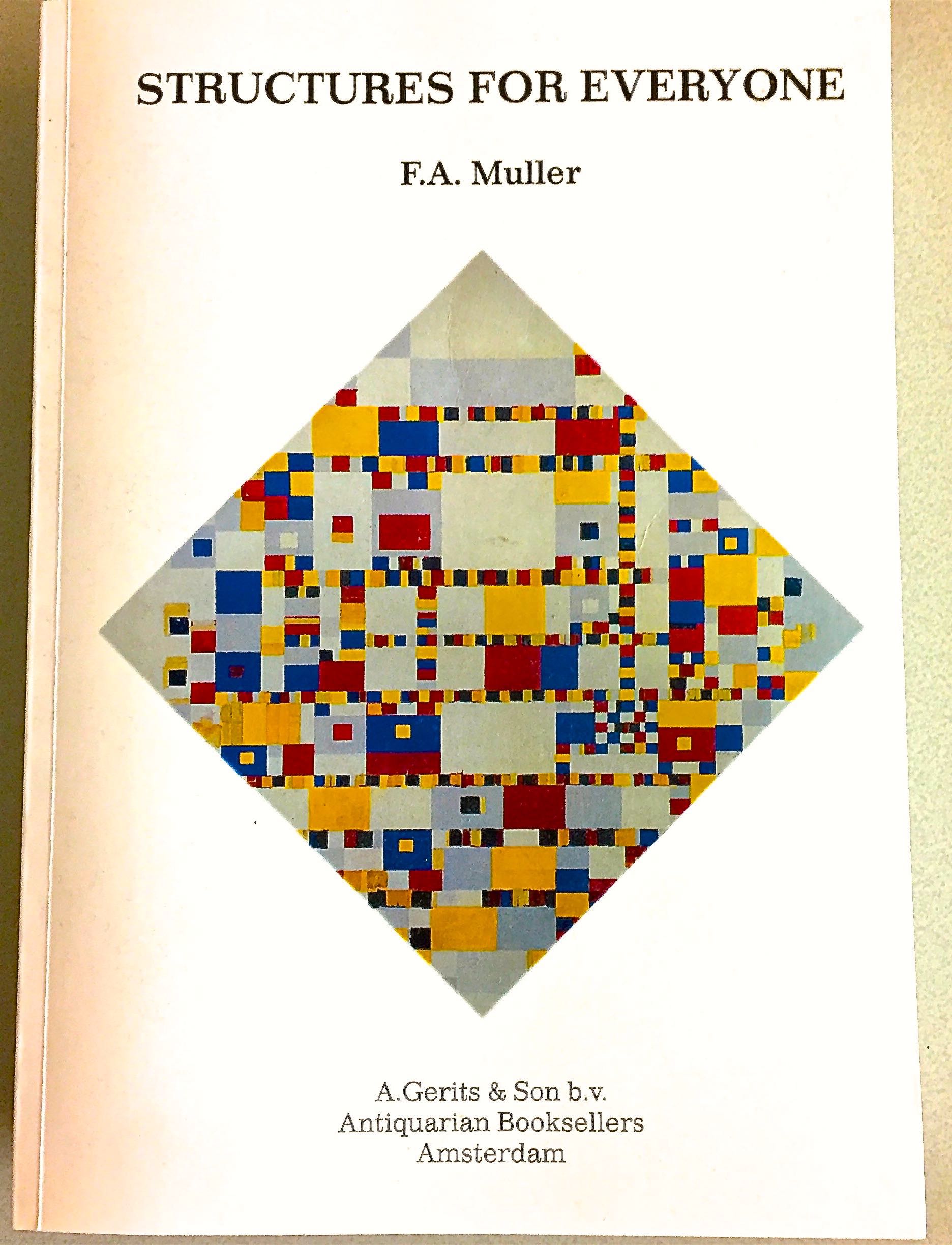

This is my thesis for doctorate published as a book
by A. Gerits & Son
(Amsterdam, 1998).
For the small amount of 75 Dutch guilders (49 US $, 25 GB
Pounds, 34 Euros) you can be the proud owner of a copy.
Visit a bookshop that has an extensive collection of
science and mathematics;
or send an e-mail to me:
f.a.muller@uu.nl
Some information about the contents follows next:
an overview of the Chapters. We mention that the book is (almost
entirely) self-contained.
Several typo's and a few incorrect formulations so
far have been discovered (contact the author via e-mail
to receive a list).
Table of Contents
- EXORDIUM
- Goals
- Philosophy of Science and Mathematics
- Prospectus and Contributions
- SET STUCTURES
- Prelude
- Standard Set Theory
- Set Structures
- The Structural View
- Set Models
- The Semantic View and the Translation View
- Appendix: More Set Structures
- MEREOLOGICAL STUCTURES
- Prospectus
- Pre-Mereological Investigations
- Mereological Investigations
- Meta-Mereological Investigations
- Conclusions
- Appendix: Proofs
- PHYSICAL STUCTURES
- Prospectus
- Introductio Logico-Historicus
- The Practice of Physics
- Physical Theories
- The Sea of Stories
- Four Grand Physical Theories
- Structural Realism
- V. QUANTUM STUCTURES
- Introduction
- Transfinite Matrices and Complex Waves
- The Equivalence-Proof
- An Architecture of Quantum Mechanics
- Interpretations of Quantum Mechanics
- SETS, CLASSES AND CATEGORIES
- Plotting the Course and Reading the Chart
- Life in the Domain of Discourse
- Cantor's Paradise and Von Neumann's Constitution
- Category Theory
- Sets and Classes
- Structuralism
- Opera Consulta
- Summary (English) / Samenvatting (Dutch)
Text of the English Summary follows below.
Back to Contents.

Besides the
links of the
current master home page, here are a few other ones.
- General Sites
- Some home pages of or dedicated to individuals
-
Joseph Agassi
Polemic and prolific Popperian from Israel
-
Aristotle's works
Philosopher most often referred to.
If philosophy is a collection of footnotes to someone's work, this is it.
-
John Baez.
Staggering home page of a staggeringly productive
mathematical physicist, about all conceivable aspects of physics,
and about the `reverse Sokal-hoax'
-
The International Berkeley Society
Esse est percipi
-
Simon Blackburn
Mainly philosopher of language
-
J.N. Butterfield
Referred to as `the Mersenne of philosophy of physics'
Criterion: a paper is a paper belonging to the philosophy of physics iff Jeremy
Butterfield is in the acknowledgements.
-
Rudolf Carnap
Luminary of the Vienna Circle
-
David Chalmers
Philosopher of mind who has discovered a position that no one believes
-
The Noam Chomsky Archive
Celebrated Linguist.
Also an engaging and self-sufficient critic of the policy
of every single government of the US.
-
Daniel Dennett and some
publications .
Philospher of mind who does not believe in consciousness but does
not admit it
-
The Einstein Archive and
Einstein on line
Physicist who became an icon of what he was: a genius.
For his two epoch-making contributions to physics he did not
receive the Nobel-prize.
-
Umberto Eco
-
The Everett FAQ
-
The Feynman Web Ring
-
B.C. van Fraassen
Creator of Constructive Empiricism, a view of science that drives
realists against the wall because they cannot confute it.
-
The Galileo Project
The scientist who separated science from religion to protect the last-mentioned
from the afore-mentioned. We hold him fully responsible.
-
The Kurt Gödel Society
-
Gerard 't Hooft
Inventor of Nobel-prize winning renormalisation procedure for Non-Abelian gauge theories
has a Sesame-Street-like homepage.
-
William James
-
The Immanuel Kant site
-
John Locke
-
The Kubrick Site
- Joseph K.'s
Kafka Page en Leni's
Franz Kafka Page.
-
N.P. Landsman
For mathematical physics.
-
Menno Lievers
Dutch analytical philosopher; publishes mainly in the newspaper
-
J.R. Lucas.
Comment. This site includes papers on Lucas' Gödelian argument which purports
to show that human consciousness cannot operate like a computer, i.e. does not run
according to some algorithm. The physicist
Roger Penrose achieved world-wide popularity with this argument
in his The Emperor's New Mind (1989), although it was already discussed at
some length ten years earlier, by Douglas
Hofstaedter in his Gödel, Escher, Bach: an eternal golden braid
(1979).
-
Von Neumann's
life and a
site which focuses on his contributions
to the computer.
-
Newton Resources and
Virtual Newton Museum
-
Friedrich Nietzsche Society and Helmut
Walther's
Nietzsche site
-
Julius Robert Oppenheimer
-
The virtual Pauli exhibition
-
Charles S. Peirce
-
The Karl Popper Web.
The `friesians'
believe that Popper was the greatest philosophers since
Francis Bacon;
critical assessment of Popper.
-
A.N. Prior
Founding father of time logic
-
Hilary Putnam
One of the best 20th-century philosophers of the USA;
changed his mind many times
-
W.v.O. Quine
Huge site, maintained by his son.
-
The Ayn Rand Institute
-
Henk W. de Regt
Dutch philosopher, lives on the border of
general philosophy of science and philosophy of physics
-
C.W. Rietdijk
A provocative Dutch rationalist of sorts
-
The Bertrand Russell Society
-
John Searle
Philosopher of mind who believes in consciousness and admits it
-
Stewart Shapiro
Philosopher of mathematics
-
Quentin Smith
Philosopher of many subjects and
confutator of claims of believers.
-
Alan Sokal
Full of responses to critics of his by now
legendary hoax
-
Studia Spinoziana
-
R.F. Streater
Mathematical physicist. Advice on which topics not to study.
-
Simon Wolfe Saunders
Philosopher of physics
-
Alan Turing
-
The Voltaire Society of America
-
Ioannis Votsis,
structural realist from Cyprus, PhD under John Worrall (LSE),
roaming around on the European continent.
My impossible co-author.
-
Steven Weinberg
Theoretical physicist who also writes about the history of physics
and issues of general interest (eg. the `Science Wars')
-
Process Philosophy of A.N. Whitehead.
-
Ludwig Wittgenstein, includes links to other
Wittgenstein-sites. Summaries of
books on Kripke's provoking analysis of Wittgenstein.
Austrian Wittgenstein Society.
- Miscellanea
-
Darwin Awards Archive
Contains stories of specimen of our species who sacrificed
themselves to enhance the quality of the human gene pool.
-
abe-books (global network of antiquarian book sellers)
and
bookfinder and
are the places to look for books which are out
of print.
-
De Academische Boekengids is supposed to be a Dutch
version of
The New York Review of Books
-
Advertisement of Dutch cultural-literary periodical
Hollands Maandblad .
This is the only Dutch
cultural-literary journal which is not subsidised;
occasionally I publish
in it (see Selected Other Publications).
It contains (very) short stories, poems, drawings, polemics, essays
on a wide variety of topics and short notes, which usually
comment on current cultural-literary affairs. It was founded in 1959
by the late K.L. Poll, a literary critic and poet who also invented
the weekly cultural-literary supplement to
the newspaper where he worked (NRC Handelsblad, today
every respectable newspaper has such a supplement);
since 1994, Bastiaan Bommelje is editor in chief.
-
Carl Sagan's Baloney Detection Kit.
-
W.F. Hermans.
- Some useful sites
Back to Contents.